
Transformed in Christ has now moved to http://www.transformedinchrist.com. Same blog, new website. You can continue to follow the Transformed in Christ blog there for thoughts and ponderings on evangelisation, catechesis, and discipleship.
Some exciting news…

Well, people, there’s been a long build-up to this and it has been somewhat hectic since I’ve been squeezing it in among everything else… But – finally! – I can let you know that the Confirmation programme I have written will be published and available to buy in early July 2014. It is being published by the wonderful people at Gracewing, and is named after this very blog – “Transformed in Christ”. It is a parish Confirmation programme for young people aged 12-16. You can read more about it at … drumroll … my brand new website – here! – http://www.transformedinchrist.com.
It has been a very long journey to get to this point, mainly because I have been doing it in my spare time. Originally, I wrote the programme for the candidates at Holy Ghost, Balham, and then, after years of piloting in other parishes, gathering feedback, and so much editing we must be on at least the 100th draft, we are there!
So, my blog too is moving over to this new site, and the old site will eventually disappear altogether. I will still be blogging on all areas of evangelisation, catechesis, discipleship… And if you’re a subscriber, you will move automatically to the new site. The conversation about good catechesis continues!
Now, I must tell you in a blushing kind of way, that I am quite proud of this little (well, it is actually quite big) Confirmation programme… I have seen the effects it has had on young people coming to a personal relationship with Christ and realising that the Gospel message was for them. I will never forget the look on one girl’s face when she heard the ‘God the Son – Gospel Message Talk’ in the evangelisation retreat one year (you can see this in the Catechist’s Guide). This was a girl who had been coming faithfully to Mass all her life, with a great Catholic family. But I realised at that moment that she had had a “penny-drop” moment – she realised this was for her. Her father told me after the retreat how she had come back full of joy – something had changed.
This is what evangelisation and catechesis with teenagers is all about. The programme consciously invites them into a life-giving, transforming relationship with the Lord every step of the way, and then it gives some comprehensive teaching to deepen the appropriation of the kerygma.
Many people have said it is unrealistic for a parish to undertake a programme with 22 sessions. I realise this is a big step for many parishes, and I have written some suggestions to those who have this question (as well as other questions) here.
Finally, I want to say how grateful I am to an amazingly long list of people named at the beginning of the Catechist’s Guide. Catechists and priests at Holy Ghost, those who have piloted it in their own parishes, those who have supported, encouraged and advised along the way. Thanks be to God for the communion of the Church! We never do anything worthwhile alone.
I want to thank in particular some real stars…
Kathy Kielty – who designed the programme and whose work you can see here. Kathy is a catechist at Holy Ghost, totally gets Confirmation catechesis, and it has been a great joy to work together on this project.
Simone Lia – who has contributed the illustrations for the programme and whose work you can see here. Simone’s work captures in a gentle yet honest way our relationship with God, and I am excited at this added dimension. Her illustrations are humorous yet powerful in communicating God’s love and therefore calling us to conversion.
Edward Morton – whose photography we have used throughout the programme and whose work you can see here. Eddy’s heart for evangelisation really comes across in these beautiful images.
So – please spread the word, like and share the Transformed in Christ Facebook page… Thank you! 🙂
Evangelisation: From the Mission Field #2
“‘In the desert, people of faith are needed who, by the example of their own lives, point out the way to the Promised Land and keep hope alive’ (Benedict XVI). In these situations we are called to be living sources of water from which others can drink. At times, this becomes a heavy cross, but it was from the cross, from his pierced side, that our Lord gave himself to us as a source of living water. Let us not allow ourselves to be robbed of hope!” Evangelii Gaudium, 86

In this series of posts, “From the Mission Field”, I am sharing some inspiring stories… people open to the Holy Spirit, allowing him to do amazing things in their corner of the world. May these stories encourage us to keep fanning into flames the little fires we’re starting in our own little corners…
#2 Evangelising Birmingham – Collette Power

I met Collette a few years ago at a Youth 2000 leaders’ weekend: straight away, it was like meeting a kindred spirit. As soon as I mentioned I worked for a parish in Balham, Collette shared her own passionate love for evangelisation, and we were off…
Collette is 26 and lives and works in the Archdiocese of Birmingham. Over the last few years she has led and developed the 2nd Friday project in Birmingham, a lay-led young adults’ movement with a focus on discipleship and evangelisation. She has now turned more towards parish ministry as well as freelance social communications work for the Church.
Collette, give us a snapshot of some of the evangelisation initiatives in your parish and in Birmingham – what’s going on?
During the two and a half years I led 2nd Friday, a small team of us – through the power of the Spirit – grew the group from six to over 100 young adults at each meeting. The meetings included Confessions, Mass and Adoration, teaching and fellowship. The focus at 2nd Friday has always been recognising how isolating it can be to be a young adult in many of our parishes, gathering young adults together for fellowship and formation and then sending them back to their parishes and places of work and study to bear fruit. We encouraged various works of evangelisation such as running the first NightFever in Birmingham, creating Scripture resources, founding the UK’s first March For Life, running a Life in the Spirit series, hosting a Youth 2000 retreat and much more.
This is separate from what I’m doing in my parish. Within the parish, I think you could sum up our work in one sentence: “If we aren’t leading people closer to Jesus, we are wasting our time.” Sounds simple, doesn’t it? Here are three highlights of the last year: each is incredibly basic in approach, but going back-to-basics has sparked something of a renewal across the parish…
We held a study group on finding God in the workplace and we witnessed some really beautiful conversions here. It was amazing to see parishioners realise that God wants a relationship with them Monday-Friday as well as weekends. Work is meaningful to God and He desires to meet people there.
Another little thing was offering parishioners something on daily prayer. We printed a sheet with a brief outline for morning and evening prayer and taught the parish to pray. People were encouraged just to add one minute in prayer to the start and end of the day in prayer and to increase this as they felt more at ease in God’s presence.
Finally during Lent, we organised a Life in the Spirit-style series, with the simple aim of helping parishioners have a more personal encounter with Christ. Each week we met for adoration, fellowship and a talk on the basic message of the Gospel. We were blessed with about 60-70 parishioners coming each week, including many who don’t do “extra-curricular”, lapsed Catholics and also evangelical Christians from the local churches. The climax was a night of renewing or making our commitment to Christ. I was moved to tears as I witnessed parishioners dashing to the foot of the altar to say yes to Jesus. About 120+ people attended this session and it was an incredibly graced moment in the life of the parish.
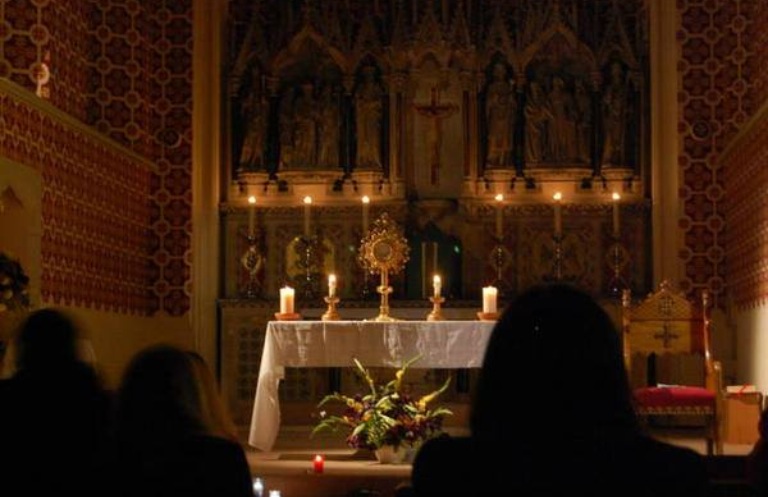
These sessions also set a compass for “where next?” I was blown away at the final session when parishioners (and some of the unlikeliest people) were firing out ideas for mission. “We need to get out there and share Jesus with the whole of our town” was the common theme. It highlighted for me, what Pope Francis talks of in Evangelii Gaudium about an evangelising community going out in boldness because they know the Lord loves them and He takes the initiative. There is definitely an air of ‘holy boldness’ about the Church at the moment.
Going forward, we have a parish and school mission with the parish community next month. We are also looking at increasing adoration in the parish and are in the process of establishing cell groups.
Has it always been like this? How did it all begin?
No, it hasn’t always been like this. I left my parish to seek fellowship with other Catholics my own age and to grow in my faith. In doing this, I realised that there was very little on offer in my diocese for people my age and I ended up being asked to look after 2nd Friday. This was a catalyst for a whirlwind of young adult formation, activity and evangelisation in our diocese. In recent months I have felt called back into my parish to minister and witness in this setting. I would say the catalyst for renewal in the parish has been a small group of intentional disciples and our parish priest. We have got over “numbers”, focusing instead on growing this small group of disciples and in 12 months we have seen a domino effect in the parish as more and more people thirst to really know Christ. The witness of a life lived for Christ is very powerful and very attractive.
I think it begins when you recognise something is missing or not right in your community and you realise that you are being called to respond to that situation or need. At 2nd Friday there was the realisation that there was very little on offer for young adults in our diocese. In the parish, it was the realisation that we needed to renew our relationship with Christ, we needed to cultivate discipleship.
I truly believe that God places you in certain settings and shows you certain things because he desires you to do something about. Feel annoyed that there are no young people in the church? Does it irritate you that you have to travel outside of your parish to get faith formation? Maybe you wished your parish had more outreach to the poor or even a NightFever. Whatever it is, take it as a personal invitation from Christ to remedy that ill. He has no hands but yours. That’s how any mission starts…
Can you tell a couple of stories where you could see the Holy Spirit working? What has God done?
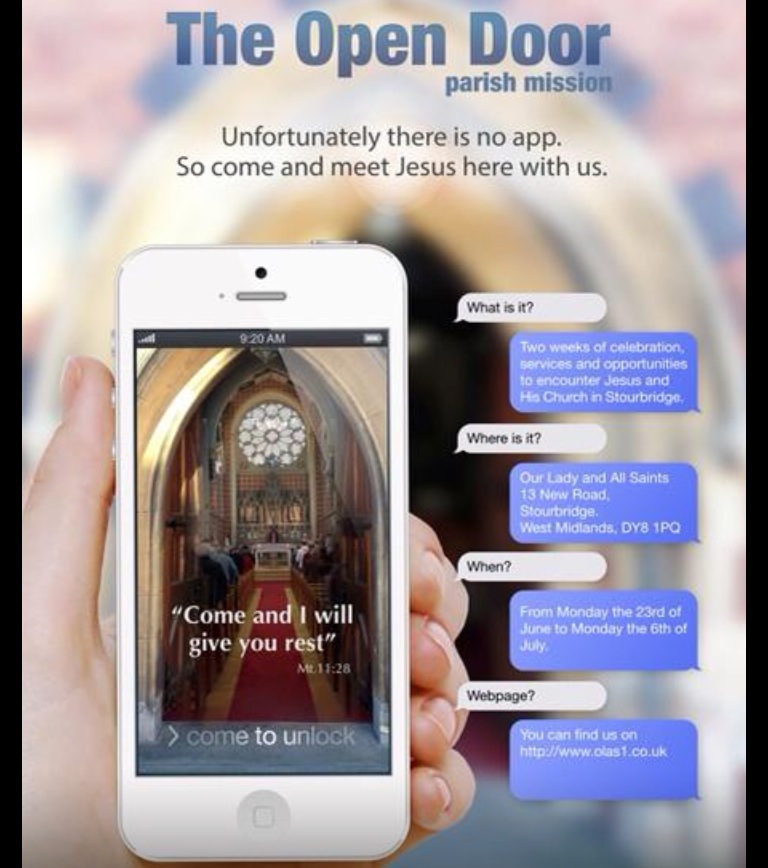
Parish mission flyer
There are four stories (among many others) that I want to mention…
2nd Friday was really a beautiful gift from God. I was asked to look after the project, not even a year after coming back to the Church. I felt completely out of my depth but I begged God to send me young people and my, did He deliver! The Lord sent young people in their abundance, he sent priests to minister to us and he sent all the resources we needed to do his work.
Another story: years ago we hosted the UK’s first “March for Life” rather unintentionally. What started as a local event to mark the halfway point in our 40 days for Life campaign, ended up on Facebook six weeks before the event and we were soon welcoming people from across the UK. We had six weeks and no money to pull off this event; but through the power of prayer, the Lord sent us everything we needed. It was a testing time for all involved and we spent the best part of that six weeks storming heaven, but the Lord answered our prayers so beautifully and each time we received something we were back on our knees praising! “Thank you God for that power generator”; “We bless you Lord for sending us more helium”. The holy high we had at the end of the March was indescribable.
Another amazing thing that happened in the last few years: my friend, Lise and I founded a blog called ‘Generation Benedict’ in the wake of Pope Benedict’s abdication as a response to all of the negative press. The blog simply shared the stories of young people whose life had been impacted by the ministry of Pope Benedict. What began as a little idea quickly went “viral” and we were fielding interviews from across the world on the “youth and B16”. The blog was later nominated for a new media award and we received correspondence from the Vatican thanking us for our work. The whole project highlighted to me how God can use social media in such a powerful way to spread the Gospel and I’ve been hooked ever since!
Finally, we ran Nightfever in the parish about 18 months ago with the help of Youth 2000. It had an incredible effect on the parish, particularly how it renewed belief in the power of the Blessed Sacrament. It also made a great impression on our parish priest, who was initially very resistant to hosting Nightfever. He talked at Mass after the event of how the Lord changed his heart that night and how we just need to get out there and share the Gospel because people need it and God will equip us. This had a profound effect on the life and mission of the parish.
In your view, what are some of the key ingredients to fruitful evangelisation?

March for Life
Prayer, prayer and prayer: essential! Pope Francis has often spoke about evangelisation starting on our knees in prayer, and this is so true. In prayer you cultivate your personal relationship with Christ and this is vital. Once your life has been touched by the life and love of the Risen Christ, you can’t help but want to share it with others. Prayer is also a vital place to test ideas for mission. Evangelisation is God’s work, we are just his instruments so we must always ask, “Lord is this what you want? Lord show me your will. Show me what you desire for our parish…”
I also think a passion for God’s people is another essential. When you launch a new initiative or project, it isn’t about ticking a box, it involves real people. Working with people can be really messy but God desires to enter this mess and it is where he works best. A passion for people means never giving up on a soul because the Lord thirsts for that person more than we can ever begin to imagine and he desires to use us to lead that person to Him.
Finally surround yourself with a good team! I am very blessed to have some close friends and priests in my life, to bounce ideas off, sharpen vision for certain projects and just pray together. We share a lot of the same desires and it is great to be able to encourage, challenge and inspire each other as we seek to do the Lord’s work.
From the outside, evangelisation in Birmingham seems to be flourishing… But what are some of the most difficult things that confront you? What discourages you and how do you deal with discouragement?

Youth 2000 Retreat
I think one of the hardest things is resistance to anything new in the life of the Church. You expect it from people outside the Church but when it comes from the people who should be on the same team: that’s tough. But I think that is probably a common experience across the Church and one that doesn’t bother me as much as it used to. I find criticism of what we do and even of what we aren’t doing hard but my response to that will always be “so what are you going to do about it?” The call to build the Kingdom is given to everyone, not just a few. If you aren’t happy that something isn’t happening in your parish or diocese, then maybe God is calling on you to do something about it.
I think one of God’s best gifts to remedy this has been working with an incredibly supportive Archbishop and also with Priests who have got your back. Archbishop Bernard has always been a great supporter of our apostolate, he would personally invite young people to 2nd Friday when visiting parishes across the diocese and would write and speak about our various initiatives. Unity with the our Bishop has always been important in our apostolate and knowing he supports our work, gives me a confidence that we are on the right path and helped me rise above difficulty and discouragement. In the parish setting, the support of a priest who believes in his young people and gives them real responsibility for mission in the parish because he values the gifts God has given them is a great remedy to discouragement. This unity with the Church brings a great peace in the face of difficulty.
How do you balance your work in evangelisation and the rest of your life?
To pay the bills, I work part time for Clinique at the moment. I don’t think “balancing” features in my vocab. To evangelise and share the good news of Jesus is such an integral part of my baptismal calling – it is hard to separate “evangelisation” and “life” because they are so closely tied. Through my secular employment, God has entrusted me this mission field and affords me many opportunities to share the Gospel here. For many people I am the only contact they have with the Church. So I pray for moments to share the Gospel throughout the day and to be able to spot the opportunities given to me to witness to the Gospel. The other night I was at an Irish Dance class (it is one way I take “time out” from Church “stuff”) but even in that class I ended up having a conversation with two ladies about IVF and contraception. I was able to speak about the beauty of the Church’s teaching into this situation and it just illustrated to me, we don’t get time off from the mission, even if we try!
If you had one piece of advice to a budding evangelist who wants to ignite a blaze, what would it be?
Don’t be afraid of doing something new for the sake of the Gospel. It’s from the Lord, he will send you all you need to accomplish it. I truly believe God honours those who seek to do His work; be confident that God has got your back. As the Popes have often reminded the youth, the Church needs your creativity, generosity and enthusiasm today not tomorrow. So be bold and dream big! And always stay close to the Church and your priests.
Any final words…?
Love Jesus. Love His Church. Love His people.
HTB Leadership Conference
I can’t let this week go without writing about the HTB leadership conference… Now, nearly a week later, it’s like trying to grip onto the wonderful gifts of God we received, and not to forget anything.
As ever, it is hard to know where to start. The greatest blessing of the conference I think had to be Rick and Kay Warren. They were mind-blowingly honest, open, humble, passionate, straight-talking, vulnerable, challenging… I just want to pick out a couple of things that really struck me.
Kay Warren spoke about Mark 8:34 – picking up your Cross and following Jesus. I cannot do justice to what she said, and I am on the edge of my seat until the full video is online to watch it again. It seriously challenged me. She called us to be “dangerously surrendered”, “seriously disturbed” and “gloriously ruined”… Dangerously surrendered – by allowing God to have authority over everything in our lives. What do I still hold back for myself? Plans about my future, my money, friendships, fashion, my own space? Seriously disturbed – to allow what deeply disturbs the heart of God – injustice, poverty, violence, torture – to disturb us. ‘Picking up your Cross’ does not mean carrying the sufferings of our everyday lives. No – it means stepping outside our lives and picking up the Cross of the world’s suffering and lack of God. Gloriously ruined – whatever we do, suffering will come our way. In the ruins, we can allow God in to transform them, to make them glorious.
On the final night, Rick Warren called us to love passionately the Church. His challenge to us was to be less involved in ‘para-churches’ (I suppose we could say organisations) and more deeply involved in the local church, in the parish. This is such an important challenge to Catholics! Most of the time, we are content to spend an hour and a half at our parish a week. We run a mile as soon as a difficult situation arises, or if the liturgy changes, or if there are personalities we don’t gel with. No, let’s give ourselves to our parishes, difficult and broken though they may be…
There were apparently 800 Catholics present this year, and I know that for many of us it is an enormous blessing. The Leadership Conference has deeply blessed and encouraged me in my life. It seems to have a quality of anointing and of true ecumenism. There were a few things I came back determined to do – to begin our small house group here with friends in Portsmouth; to begin praying together with others at work. This is just scratching the surface. There is SO MUCH we can learn from HTB – their hospitality, their service, the openness and freedom of their worship…
Holy Spirit, renew the face of the earth!
The Church and Discipleship
I came across this video earlier this week. Obviously, it comes from a Protestant context (so their concept of worship is not ours), but essentially, it is saying exactly the same thing that we Catholics have been hearing time and time again recently. Here are just a couple of examples from Evangelii Gaudium (that we by now know pretty well):
I dream of a “missionary option”, that is, a missionary impulse capable of transforming everything, so that the Church’s customs, ways of doing things, times and schedules, language and structures can be suitably channeled for the evangelization of today’s world rather than for her self-preservation. (EV, 27)
We must admit, though, that the call to review and renew our parishes has not yet sufficed to bring them nearer to people, to make them environments of living communion and participation, and to make them completely mission-oriented. (EV, 28)
However, this video raises some questions for me. The experience of a typical English parish is precisely not an overload of programmes or events. If only! From my experience of average parishes, you’d be lucky to turn up on a given evening and find anything going on. (Recently, I heard of a man (not a Catholic) who contacted the local parish of a town he was staying in overnight with business. He wanted to know if there was a prayer meeting, or something else he could attend in the church that evening. The response he received from the parish secretary? “Sorry, nothing’s going on.” How sad! What a missed opportunity.)
It only makes sense to send out disciples to evangelise. After all, “A person who is not convinced, enthusiastic, certain and in love, will convince nobody” (EV, 266).
So the call of this video (and to some extent, Pope Francis’s call, too) seems only to make sense to a parish community which already has disciples – which provides formation, has a sense of purpose and mission among even a small percentage of its parishioners.
Earlier in the week, a post from an evangelical Christian friend of mine appeared on my newsfeed. He spoke about how his church has grown over the last two years: they have built a community projects building which houses projects such as a food bank, money advice, child bereavement support, and youth and children’s ministry. He finished by saying how his church is reaching 600 members on a Sunday. 600! This is what they have achieved with up to 600 disciples. Sadly, how many Catholic parishes of 1000+ parishioners could claim anything like this?
The reality of most parishes is that we’re at ground-zero, and you’d be fortunate to find your church even open during the day, let alone to stumble across a core group of disciples. It’s not possible to send out Mass-going Catholics who are not disciples to proclaim the Gospel. What will they be calling people to? To be a part of a cultural ‘club’, rather than a life-giving relationship with Jesus? Unless we are disciples “in love” with the Lord, we will evangelise no one.
My response to this video, then, is that, for a first step at least, there’s a need to concentrate on programmes and events, of awakening within the baptised their call to holiness and evangelisation, before it is possible for people to be sent, to “go out”.
Evangelisation: From the Mission Field #1
“‘In the desert, people of faith are needed who, by the example of their own lives, point out the way to the Promised Land and keep hope alive’ (Benedict XVI). In these situations we are called to be living sources of water from which others can drink. At times, this becomes a heavy cross, but it was from the cross, from his pierced side, that our Lord gave himself to us as a source of living water. Let us not allow ourselves to be robbed of hope!” Evangelii Gaudium, 86
Anyone in need of some ENCOURAGEMENT?!
In this new series of posts, “From the Mission Field”, I want to share some of what I can see the Holy Spirit doing through some wonderful people around the country. These are just some people I have come across, whose openness to the Holy Spirit is achieving marvels that most will never hear about.
Here, I ask them about how they evangelise in their corner of the world, what God is doing, and how they face challenges and discouragement. My hope is that it will bring you courage as you evangelise in your own corner of the vineyard…
#1 Salisbury Youth Ministry – Xanthe Dell

So, kicking off with youth ministry… I first met Xanie on a week’s silent retreat in France. She was accompanied by several teenagers (kinda normal for Xanie). Being in silence, we didn’t speak to each other the whole week, but at the end I felt like I knew her as a sister in Christ. I haven’t stopped being impressed by her ever since…
Xanthe is a Deanery youth worker in Salisbury, a role which includes chaplaincy work in a secondary school. She is mum to Daisy (16) and just celebrated three years as a Catholic.
Xanie, we hear amazing things about the youth ministry in Salisbury. What do you have happening?
We have five weekly groups for varying ages, a monthly youth Mass and retreats here, there and everywhere, and seasonal activities.
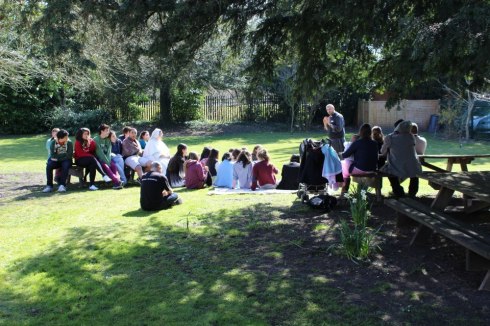
We’ve also started a mission team, called ‘The Third Hour’. The idea came from a visit we did to Nailsea for a youth Mass. Sadly not too many young people came at that time from the parish, but it did strike me that we seemed to have a complete mobile youth Mass on our minibus (except the priest!). The next thing that prompted us was that convincing our Confirmation group to come on Youth 2000 retreats seemed so difficult. I realised that because they had never experienced any sort of youth retreat, they couldn’t raise enthusiasm to come along. The two slipped together and so we try to take a mini youth retreat to young people in other parishes, in the comfort of their own church. The lovely thing is that it is not just a Salisbury based team now, young people from all over the country come to help out running the programme. There is still some polishing up to do to make it smooth and professional but the impact is powerful.
Has it always been like this? How did it all begin?
Fr Tom (Dubois) started three of the groups: a youth SVP, ‘Source’ for young people aged 10-14, and ‘Upper Room’ once a fortnight for those age 15 and up. It was those very small groups that really became the foundation of the youth ministry. It doesn’t matter how fantastic your programme is or how dynamic you are as a youth leader – you need a few enthusiastic young people to start things off. It is the young people who bring the other young people in.

Where have you seen the Holy Spirit working? What has God done?
I think the most powerful work of the Holy Spirit I see is the transformation of some of these young people through the sacrament of reconciliation. The more they struggle to take themselves into Confession, the more they seem to receive from going – it is truly beautiful to see them emerge unburdened and free and always deeply touches me.
There are times when you see the light of Christ just come alive in them – when you get a text at 1am in the morning because they have just had the most special time of prayer, or have just had a deep conversation with an atheist friend and they are desperate just to share that.
Those times when you think no one is getting it, that everyone seems to be turning their back on their faith, and then 10 young people walk in for a weekday Mass just because they can – that’s amazing. So many graced moments.
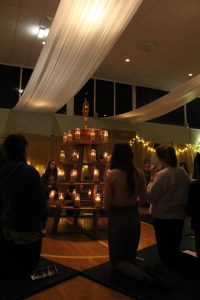
One that particularly stands out to me was during a session that I do at the school for girls. The girls had a piece of cord with a crucifix on the end, the idea was to tie a knot in the cord for every worry or burden they were carrying and then to pray a Hail Mary on each of the knots all day, keeping the cord in their pockets. One girl I noticed had run out of cord there were so many knots, I asked her if she really had that many problems or had she just got carried away. She started to tell the saddest story to the group: her father had left, her mother couldn’t keep her older brother out of trouble and he was potentially going to be taken into care. When I looked around I noticed the girls had all started tying another knot in their cords, I looked puzzled but one of them explained that they were going to be praying for this girl’s burden too. I was so touched by the beauty of this unspoken understanding and compassion from mostly unchurched children that it still gives me a lump in my throat.
In your view, what are some of the key ingredients to fruitful youth ministry?
Christ and prayer. It may sound obvious, but I get a lot of pressure from parents to provide table tennis or pizza nights.
While this has its place, Jesus has to be the centre of everything we do here. The moment I push Jesus to one side I’m not serving any purpose other than being a child-sitter. There is the misconception that if you mention Christ, all young people will run in the opposite direction. The reverse is true – if all we do is just whisper his name in an opening and closing prayer, we are saying that this is not going to interest you; what we have is not important or worthwhile. It is now very countercultural to be religious! Shout about it and they will too. When we dilute our faith for young people the flavour that is the desirable part is what we remove.
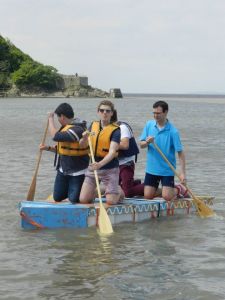 From the outside, the youth ministry in Salisbury seems to be flourishing. But what are some of the most difficult things about it? What discourages you and how do you deal with discouragement?
The hardest part is when you see young people who have had an intimate encounter with Christ still turn away at times – this breaks my heart, but over time I have come to realize that sometimes God lets them choose: like the Prodigal Son they come back stronger, more focussed, more in awe and with a real first hand knowledge of just how merciful God can be. Even knowing this it still breaks me to see it.
The lack of parental support for their children’s faith is quite often an issue too. While I see so many parents sitting without their children at Mass, praying for them to come back, there are just as many that see swimming or ballet or the Duke of Edinburgh award as far more important than anything that is happening in church. There seems to be a fear that they will become too religious, which surprises and saddens me. There is a huge opportunity for someone to evangelise the parents though!
Is work-life balance important in youth ministry and how do you manage this?
The straight answer is, I don’t! They are merged into one. It is not a job that fits neatly into set hours and days, I am available 24/7 and they know that. If I’m cooking a meal and three young people show up, they join us. Some of the older over 18s have a key to my house and it is not unusual to find them sitting round my table having a cup of tea and a chat or watching a film when I come home. It’s never been abused. It is an open door and that’s the only way I can find it works for me. It wouldn’t work for everyone and I’m blessed to be in a position to give in this way. It’s very difficult to differentiate between work and service. Do I stop being a Christian at 10pm on a Sunday evening even if I’m not being a youth worker? It is something that became too tricky to separate. I know the signs now of burning out and I take myself off to a convent or retreat somewhere and restore and refill.

If you had one piece of advice to a youth minister just setting out, what would it be?
Just one – live what you teach! If you are not going to Mass or Confession or living a moral life, it’s very hard to bring others to do it either. Your own relationship with God should be given more importance than the young people’s. It is always God who does the work through us, we are just a pen in His hand, writing on someone else’s page. We have to pray to be a useful tool and not a hindrance to what He wishes to do in these young people’s lives. When I’m living as I should then I can trust the things that don’t always look so good are all in His hands.
Any final words…?
I once read a youth ministry article asking, ‘would you die for your young people?’ It’s a big ask; far harder and more rewarding I think is to live for them. We are always given the patience and wisdom that we need for that young person at that moment. So many times I have looked to God aghast saying, “Well, you put me here, help me!” and always, always He does.
(Photos courtesy of Salisbury Young Catholics; used with permission.)
Quick Takes

~ 1 ~
Well, everyone, welcome to Holy Week. Some words before the Palm Sunday Procession today struck me:
“Let us commemorate the Lord’s entry into the city for our salvation, following in his footsteps, so that, being made by his grace partakers of the Cross, we may have a share also in his Resurrection…”
What struck me is that, if we are baptised, we are – in our very being, by grace – “partakers of the Cross”. This week, we are invited once again to enter into the Paschal Mystery and make it more deeply our own. If we are baptised, the Paschal Mystery is what characterises us. Therefore, it is almost a contradiction not to enter fully into Holy Week, not to celebrate “in our depths” the liturgies of this Week – this is “who” we are. So, let’s go with the Lord to the Cross this week, and say “yes” to the path of giving ourselves completely to the Father…
~ 2 ~

On a slightly lighter note: let me introduce you to one of my sisters, Tess 🙂 (This photo was taken many moons ago…) She has recently started her own blog, At the Heart of the Home, which I encourage you to go and see. Lots of cute baby photos of my little nephew and thoughts and reflections on being a new wife and mother…
~ 3 ~
Recently, I was reminded of a wonderful phrase (from de Lubac), “the Eucharist makes the Church”. It made me stop and wonder: how important this is when we think of evangelisation, when we think of drawing people into the Church. It is the Eucharist that points to, and also makes real, the communion between us. It is the Eucharist that effects the communion with God and each other that we all long for.
Mgr Kelly, in The Mystery We Proclaim, speaks of one of the goals of catechesis as community, or perhaps better to say, communion. Communion reminds us that we are called into the communion of the Blessed Trinity, which lifts our fellowship with others to a level of grace. This is the miracle of the Church! I often wonder at all the deep friendships I have in the Church, and think that I would not ‘naturally’ be friends with many of these people – but in the Church, through the Eucharist, we share a oneness and closeness that I don’t share with others who are perhaps more ‘naturally’ my friends.
This just reminds me that the Eucharist should be at the very heart of all our evangelising and catechising efforts. After all – everyone’s favourite! – CT, 5: “the definitive aim of catechesis is to put people not only in touch but in communion, in intimacy with Jesus Christ: only He can lead us to the love of the Father in the Spirit and make us share in the life of the Holy Trinity.”
~ 4 ~
Evangelising the culture is all about seizing on opportunities, being creative, and thinking outside the box… A good friend of mine lives and works in Poland, and they are doing just that for the upcoming canonisation of John Paul II: I just love some of these fab ideas: In addition to concerts, exhibitions, debates, and a documentary film, they are launching a JP2 app, an outdoor game (involving places all over the city visited by John Paul II), a JP2 wikipedia (“WikiJP2”), a 26-day spiritual workout Facebook initiative, and ‘I ❤ JP2’ luggage stickers to be distributed at airports! Fab, huh?! What a wonderful opportunity to evangelise in the public square.
~ 5 ~
Finally, if you haven’t done so already, sign up for the Called and Gifted workshop (first one to happen in the UK!) which will be led by Sherry Weddell from 27-28 June. You can sign up here (please note the option for those who live outside the Diocese of Portsmouth).
Youth Evangelisation
Have just returned from The Weekend of the Two Youth Retreats. Yesterday, we held a diocesan Confirmation retreat led by Youth 2000; and today, I went to Salisbury to Expression, and led a workshop. I hope to write more about Salisbury soon, as their youth ministry is a beacon of light in our country… it is thriving and bearing much fruit.
On the subject of youth evangelisation, I love this little clip… A great clip to use for forming young disciples on how to evangelise.
Thresholds of Conversion and RCIA

This is a much-discussed topic at the moment. A lot of us are waking up to the fact that the ‘catechetical’ aspect of RCIA is the relatively ‘easy’ bit. We have some clear guidelines for catechesis (e.g. through wonderful organisations such as the Association for Catechumenal Ministry). It should be Christ-centred, scriptural, liturgical, systematic, kerygmatic. OK – so far, so good.
The difficult thing is the evangelisation bit.
One priest shared with me recently that when he moved to a parish, he implemented a thorough and solid doctrinal programme for the RCIA. And do you know what? The outcomes of this resulted in conversions seemingly no deeper than the previous, less thorough, less doctrinal programme had yielded.
This is something we really need to take on board. Doctrinal catechesis does not necessarily lead to conversion.
I have been re-reading Forming Intentional Disciples on the thresholds of conversion (for a summary, see pp.129-130). Just to recap:
1. Trust: A positive experience, or friendship, which leads someone to have a relationship of trust with God or the Church
2. Curiosity: Someone is intrigued to know more – about Christ, or about some aspect of the faith
3. Spiritual openness: The person acknowledges to him- or herself that they are open to the possibility of personal change (this is not yet commitment to change)
4. Spiritual seeking: Moving into this threshold involves shifting into an active gear – an active search to know this God who is calling him or her begins.
5. Intentional discipleship: The decision to “drop one’s nets”, to make a conscious commitment to follow Jesus in the Church
Sherry Weddell suggests that the fourth threshold (spiritual seeking – the first active stage) is the perfect time to enter the formal Catechumenate in RCIA. This makes sense to me. Only when one is actively seeking God is one open to receive catechesis, the handing on of Christ and the Faith of the Church in relation to him. This fits in well with some principles in the General Directory for Catechesis. There it speaks of the importance of the “activity” of the catechised (n.157) – catechesis reflects the pedagogy of God himself, which invites an active response. Unless someone is at the beginnings of a relationship with God, there is little hope of a response in the way that catechesis, by its nature, requires.
So, this leaves us with a big question… How can the evangelisation/enquiry period of RCIA usher a person from ‘curiosity’ (which presumably they have in order to come at all) through to ‘spiritual seeking’ before they celebrate the Rite of Acceptance?
This big question can be broken down into smaller ones, which I am pondering, and invite you to share your thoughts on, too!:
- What length of time should generally be expected for this shift to take place? Is a standard enquiry period of 12 weeks long enough?
- How soon do we discover which threshold a person may be at? Perhaps a conversation with a priest or experienced catechist or sponsor early on could help to establish this.
- What precise goals can we create for enquiry to lead someone towards the beginnings of an active faith?
- And what do we do when someone cannot manage to pass through the thresholds, but is eager to enter the Catechumenate?
Some biggies… but ones I think we should tackle! 😉
“Where next?”

It often happens that you get to the end of a really fruitful programme/course/series in your parish, and people start to ask, “What’s happening next?” “We want to continue, this has been the experience of something new!” If your parish has a strategy for adult formation, then the answer is easy, because perhaps you have a number of options lined up for people who have just dipped their toes in.
But, the reality is, there are few parishes out there with a strategy for adult formation. If only!
And yet, the time at the end of a course that has awakened people’s faith, ignited their enthusiasm, and formed community, is absolutely crucial. All these little ‘sparks’ of faith and enthusiasm have been lit, and we now need to take responsibility to ‘fan’ them into stronger flames, help conversions deepen, mature, and equip people to start reaching out to others.
Firstly, if there is any chance at all of forming a small team of intentional disciples to look at adult formation, if your priest is keen, and together you can draw up a strategy, I think this is ideal. This way, a team can look at the general demographic of the parish in the light of “intentional discipleship” – what do people need? Which ‘thresholds’ are people stuck on? Which particular groups of people do we need to reach out to? There is never a single answer to address everyone’s needs, which is why I think parishes that offer lots of different formation alternatives, at different levels, are the most successful.
Secondly, if there is no possibility of such a strategic approach – perhaps your priest is not really on board, or perhaps it seems you are the sole intentional disciple in your parish! – you can still ask some of the questions above, only on a smaller scale. Above all, pray. Learning how to discern the next steps is essential, and this means frequent prayer to the Holy Spirit to show us the way. We might want to ask ourselves: Which is more urgent – deeper formation for those already committed, or primary evangelisation of the Mass-on-Sunday-Catholics? Perhaps the former needs to happen first, in order to gather a team for the latter? Prayer must underpin our efforts – especially if we are few in number, and especially if we have lots of different ideas – so that the Holy Spirit may lead us to invest our efforts where God wills – and this will be different from parish to parish.
It’s important to remember, too, that the evangelisation and formation of our parish is a matter of pastoral governance, which means that our priest needs to be at the heart of it – he’s the spiritual father of this community. So, while we are free as a bird when it comes to evangelising our friends (in fact, it’s a duty of our Baptism), when it comes to the parish, we need the priest at the centre (even though he’s not the one doing everything – and he shouldn’t be). Maybe in some cases the very first place we need to start is in praying for our priest…
Finally, nearly two years ago, I wrote this post on leadership after being at the HTB Leadership Conference and being blown away (excited to be going again in May!). (There is nothing like a bit of evangelical Christian passion and vision to blow away the negativity and blame-game-approach we often experience in the Church (sorry… but it’s true)!) One of the main points I took away was that you do not need a position to lead. Often we wait for someone to ask us to do something. But if you see something that needs to be done, and you have a passion for it, just go ahead and do it! That was two years ago and it’s still with me…

Recent Comments
Marc on Top Ten RCIA Traps Marc on Top Ten RCIA Traps solution program on Vocation, Freedom, Holiness monk johanan on The Church and Disciplesh… Jonathan F. Sullivan on Some exciting news…


 Transformed in Christ